

Walk into any busy commercial kitchen around lunch service and you'll see why food safety compliance is hard to enforce with a checklist alone. Someone's pulling gloves off to answer the phone. A hairnet has slipped down someone's forehead and nobody's mentioned it. None of it is intentional — it's just what happens when people move fast and one supervisor can't be in five places at once.
Traditional CCTV has been sitting in these kitchens for years, quietly recording all of it. But recording isn't the same as knowing. Footage only becomes useful after something's already gone wrong — a complaint, an audit, a health inspector asking pointed questions — and by then the violation happened hours ago. This is the gap AI CCTV food safety systems are starting to close, turning passive recordings into something that can flag issues as they happen.
Why Traditional CCTV Is Not Enough for Food Safety Monitoring
A regular camera doesn't know what it's looking at. It captures footage and stores it, waiting for someone to press play. There's no alert when a handler skips the sink before touching food, and no flag when raw and cooked ingredients end up on the same cutting board. CCTV food safety monitoring built on AI video analytics is different because it interprets the feed instead of just archiving it.
How AI CCTV Supports Food Safety Compliance
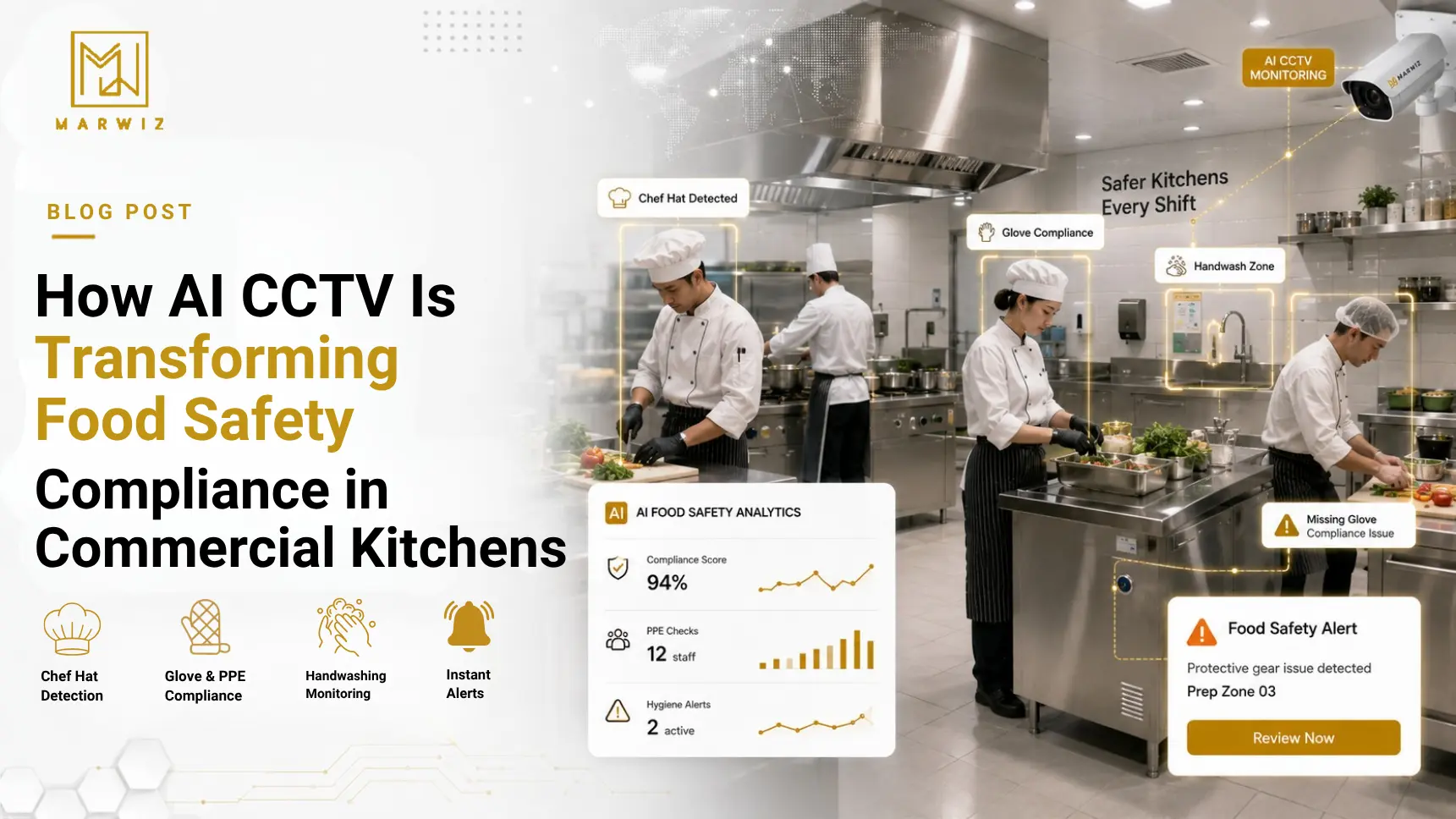
AI video analytics for food safety works by scanning live footage against behaviors the kitchen actually cares about. Instead of expecting one supervisor to watch every station at once, the system can pick up a deviation and send an alert so someone nearby can step in. It's worth being clear: this doesn't replace trained food safety staff or scheduled inspections — it narrows down where human attention needs to go first.
Key Food Safety Compliance Detections
Head coverings are usually where this starts. AI chef hat detection and hairnet monitoring can flag protective headwear worn incorrectly, and the same logic applies to gloves, masks, and aprons or uniforms — helping confirm the right protective gear is on before someone starts handling food. Handwashing compliance monitoring supports supervisors in checking staff wash up at the right points in a shift instead of skipping it when things get busy, and bare-hand food handling detection picks up moments where gloves or utensils should've been used instead.
Then there's everything around contamination and access. Cross-contamination detection can flag handling patterns between raw and cooked food worth a second look, while food area hygiene detection keeps an eye on general conditions across prep and packaging zones. Jewellery, smoking, and eating or drinking in restricted areas can all be picked up too, along with mobile phone usage pulling attention away from food handling. Unauthorized entry detection confirms only the right people walk into processing areas, and footwear detection checks staff are wearing what they should. On storage, food storage compliance monitoring can support checks on whether items are kept where they belong, and where CCTV is paired with suitable sensors, it can extend to temperature compliance and signs of mishandled stock.
Benefits of AI Video Analytics for Kitchen Hygiene
None of this is really about catching people out. The bigger value in AI video analytics for kitchen hygiene is visibility — seeing what's happening across several stations without physically standing at each one. Issues get noticed faster, hygiene monitoring stays more consistent from shift to shift, and teams rely less on someone walking the floor and hoping they catch what matters. Accountability also shifts from memory to what actually happened on camera.
Moving Towards Real-Time Food Safety Surveillance
Used this way, the camera stops feeling like a security fixture and becomes part of how the kitchen actually operates. Real-time food safety compliance monitoring means a lapse gets addressed the same shift it happens, instead of surfacing weeks later during an audit nobody saw coming.
Conclusion
AI CCTV isn't going to replace a trained food safety team, and it shouldn't be expected to. What it can do is give commercial kitchens, restaurants, cloud kitchens, and food-processing facilities a steadier way to keep an eye on hygiene and protective clothing compliance day to day. Marwiz Vision builds this kind of AI-driven video analytics for exactly that purpose — helping food businesses get more out of the cameras they already have, instead of treating them as just another recording device.
Frequently Asked Questions
Ready to get started?
Are you exploring your digital signage project needs (software and content)? Looking for just the digital signage display software or a full-scope proposal? Interested in a custom software solution tailored to your specific requirements? Would you like a personalized software demo?